Abbott Laboratories Investigates Dual Cybersecurity Breaches Targeting Cancer Diagnostics and LabCentral Portal


Abbott Laboratories, a global leader in medical diagnostics and healthcare technology, is currently navigating a complex security landscape following the emergence of two distinct cybersecurity incidents. The Chicago-based multinational has confirmed that it is investigating unauthorized access to internal legacy systems within its Cancer Diagnostics business, while simultaneously addressing claims of a secondary breach involving its LabCentral customer portal. These incidents, attributed to different threat actors, highlight the persistent vulnerabilities facing the medical technology (MedTech) sector and the evolving tactics of cyber-extortion groups.
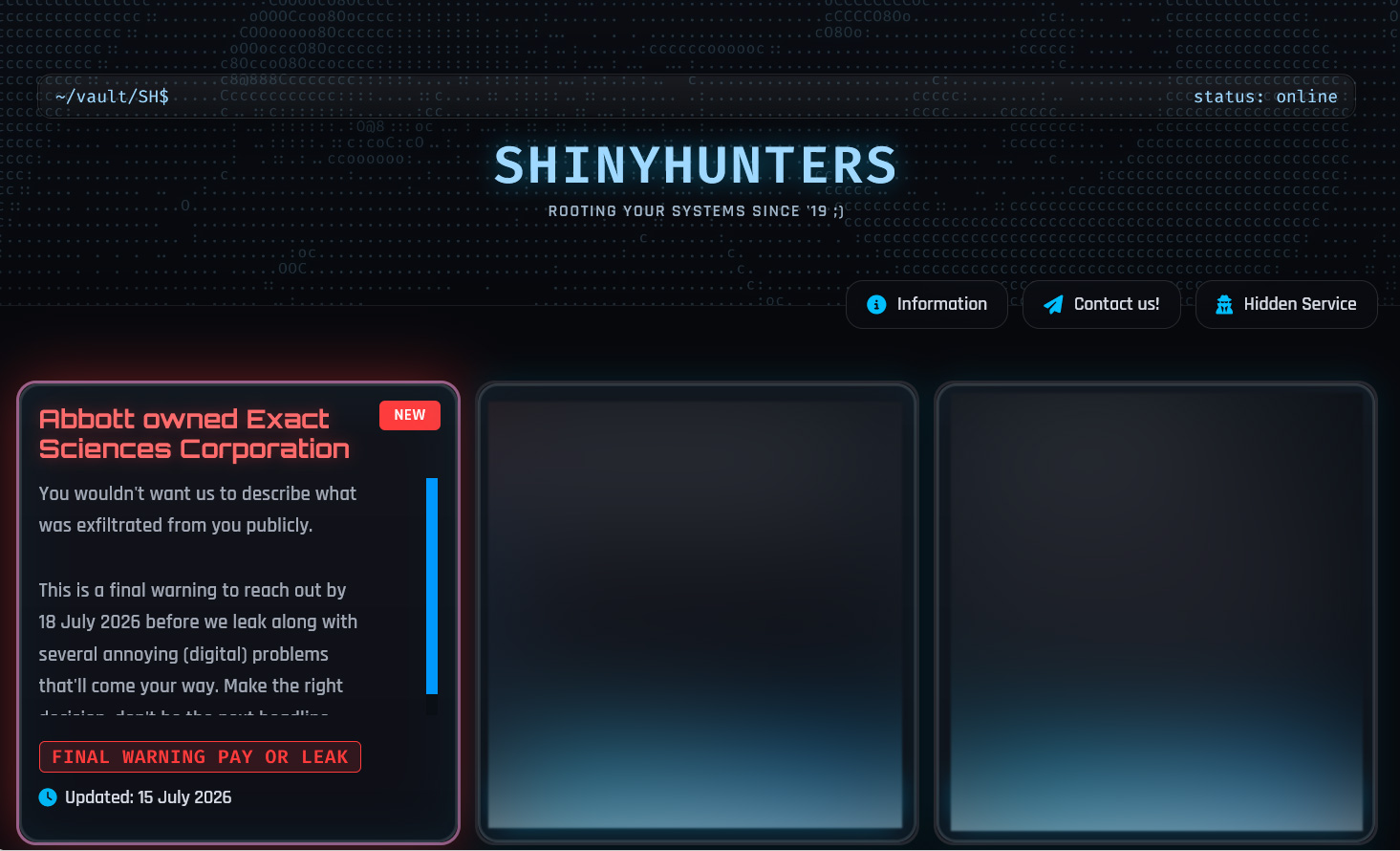
The first and more significant incident involves the notorious ShinyHunters extortion gang, which recently added Abbott to its public data leak site. According to the group, they successfully exfiltrated a massive cache of sensitive data after breaching legacy Exact Sciences systems currently under Abbott’s purview. While Abbott has confirmed the unauthorized access, the company has sought to reassure stakeholders that the breach is confined to a specific business unit and has not disrupted broader operations or patient care.
The ShinyHunters Extortion and the Cancer Diagnostics Breach
The confrontation with ShinyHunters began in mid-July 2026, when the group posted Abbott’s name on their extortion portal. Initially, the hackers set a deadline of July 18 for the company to enter negotiations, later extending that window to July 21. In communication with cybersecurity researchers, ShinyHunters claimed that the breach was the result of a sophisticated "vishing" (voice phishing) campaign initiated in mid-June.
By targeting several Abbott employees through deceptive phone calls, the attackers purportedly obtained credentials for a Microsoft Entra (formerly Azure Active Directory) single sign-on (SSO) account. This access allowed the group to bypass traditional perimeter defenses and infiltrate various internal systems. Once inside, the attackers reportedly moved laterally into integrated Software-as-a-Service (SaaS) applications.
The scope of the data allegedly stolen is staggering. ShinyHunters claims to have exfiltrated over 30 million rows of customer personally identifiable information (PII). This dataset reportedly includes names, physical addresses, email addresses, phone numbers, and dates of birth. Most concerning is the claim that the haul includes more than one million Social Security numbers. Furthermore, the group asserts it has possession of 22 million client notes detailing doctor-patient interactions, 20 million medical orders, and numerous non-disclosure agreements (NDAs) and customer contracts.

Abbott’s official response has focused on containment and characterization. In a statement, the company clarified that the incident involved "unauthorized access to a limited number of internal systems in our Cancer Diagnostics business only." The company emphasized that these legacy systems are separate from Abbott’s core infrastructure and that the breach has not impacted manufacturing, lab operations, or product availability.
The LabCentral Portal Incident: A Disputed Claim
As the ShinyHunters investigation unfolded, a second threat actor operating under the pseudonym ShadowByt3$ came forward with claims of a separate intrusion. This actor alleged a breach of Abbott’s Core Laboratory diagnostics business through the LabCentral customer portal.
ShadowByt3$ claimed to have gained access on July 4, 2026, utilizing compromised customer credentials. The actor described finding a "weak point" in the environment that allowed for the slow exfiltration of files via API endpoints. The data allegedly stolen in this instance includes technical specifications, calibrator value assignments, assay files, CE manufacturing certificates, and regulatory documentation.
Unlike the ShinyHunters incident, which involves high-value PII, ShadowByt3$ admitted that no customer data was taken. Instead, the focus was on sensitive business documents and intellectual property. However, Abbott has sharply disputed the severity of this claim. A company spokesperson clarified that LabCentral is an externally facing, third-party hosted portal used primarily for distributing technical product reference documents.
According to Abbott, the documents housed on LabCentral—such as operating manuals and troubleshooting checklists—are essentially public information provided to clients and do not constitute proprietary or sensitive intellectual property. This discrepancy suggests that the threat actor may be attempting to inflate the value of the "breach" to gain leverage or notoriety.
Chronology of the Cybersecurity Events
The timeline of these events suggests a concentrated period of activity targeting Abbott’s digital infrastructure during the early summer of 2026:
- Mid-June 2026: ShinyHunters initiates a vishing campaign targeting Abbott employees. They successfully compromise a Microsoft Entra SSO account.
- July 4, 2026: ShadowByt3$ allegedly gains access to the LabCentral customer portal through compromised credentials and begins exfiltrating technical documents.
- Mid-July 2026: ShinyHunters lists Abbott’s Cancer Diagnostics business (specifically referencing legacy Exact Sciences systems) on their data leak site.
- July 18, 2026: The original deadline set by ShinyHunters for negotiations passes.
- July 21, 2026: The extended deadline for the ShinyHunters extortion attempt.
- Late July 2026: Abbott issues public statements confirming the investigation into the Cancer Diagnostics incident and downplaying the significance of the LabCentral data access.
Technical Analysis: The Vulnerability of SSO and Legacy Systems
The method of entry claimed by ShinyHunters—vishing to compromise SSO accounts—reflects a growing trend in cybercrime. As corporations have bolstered their technical firewalls, attackers have pivoted back to social engineering. By impersonating IT support or corporate security personnel, attackers can trick employees into revealing credentials or approving Multi-Factor Authentication (MFA) prompts.
Microsoft Entra and similar SSO platforms are high-value targets because they act as a "master key" to a company’s cloud ecosystem. Once a single SSO account is compromised, attackers can often access a wide array of connected applications, such as Salesforce, SharePoint, Databricks, and ServiceNow, without needing further passwords.
The mention of "legacy" systems is also critical. In the MedTech industry, large-scale acquisitions often result in the integration of older IT infrastructures that may not adhere to the parent company’s current security standards. These legacy environments frequently lack the latest security patches or monitoring tools, making them "soft targets" for sophisticated groups like ShinyHunters.
The Strategic Targeting of the MedTech Sector
Abbott is far from the only victim in the healthcare technology space. ShinyHunters has a documented history of targeting MedTech giants, including Medtronic, OneMedical, and AdaptHealth. The group was also linked to the data breach at iRhythm and an attempted attack on Stryker.
The healthcare sector is an attractive target for several reasons:
- High Data Value: Patient records and Social Security numbers fetch a premium on dark web marketplaces compared to standard credit card data.
- Operational Criticality: The life-saving nature of medical devices and diagnostics creates immense pressure on companies to resolve breaches quickly, which attackers hope will lead to faster ransom payments.
- Complex Supply Chains: The reliance on third-party portals (like LabCentral) and interconnected lab systems provides multiple entry points for hackers.
Broader Impact and Industry Implications
Abbott has stated that it does not expect these incidents to have a material impact on its financial results or business operations. However, the long-term implications for the company and the broader industry are significant.

For Abbott, the primary concern will be the potential exposure of 30 million rows of customer data. If the ShinyHunters’ claims are verified, the company could face significant regulatory scrutiny under the Health Insurance Portability and Accountability Act (HIPAA) in the United States, as well as the General Data Protection Regulation (GDPR) in Europe. Such breaches often result in class-action lawsuits and long-term brand damage, regardless of whether core business operations were interrupted.
For the MedTech industry, the dual nature of these attacks serves as a wake-up call regarding the security of customer-facing portals and the risks associated with legacy system integration. The incident underscores the necessity of robust "Zero Trust" architectures and the importance of continuous employee training to recognize sophisticated social engineering attempts.
As of the current reporting, neither ShinyHunters nor ShadowByt3$ has released the full datasets they claim to possess. Abbott continues to work with third-party cybersecurity experts and law enforcement to investigate the full extent of the unauthorized access and to ensure the ongoing security of its global networks. The situation remains fluid as the industry watches to see if the threat actors will follow through on their threats to leak the data.
Related posts: